

Home › Guides
5 guides · 54 articlesGuides: how AI funding works
Plain-English guides to each kind of AI opportunity we track: what it is, who can apply, what it pays and how to apply, with examples from live, verified listings.
Some links on this page are affiliate links. We may earn a small commission at no extra cost to you.
Start here
Six articles that answer the questions we get most, wherever you are.
- GrantsThe AI startup funding stack: grants, credits, tax relief and equity
- FellowshipsHow to get into MATS, SPAR and other AI safety research programmes
- FellowshipsAI funding for students
- GrantsUS AI startup funding: SBIR grants, cloud credits and equity-free money
- PrizesAI prizes, grants and fellowships you can apply for from any country
- Compute creditsGoogle, AWS and Azure credits for AI startups compared
Latest
Every guide and article, newest first. New articles every week.
Find a guide
- AcceleratorsArticle
Opening a UK business account for your startup
You have registered the company and the grant or first cheque needs somewhere to land. This guide covers what UK providers ask for, the difference between a bank account and an e-money account, and what each provider publishes about fees and eligibility. It is general information taken from official pages, not financial advice or a recommendation of any provider.
6 min read - AcceleratorsArticle
Hiring abroad after your first grant
A first grant or accelerator cheque often comes with a first hire, and for AI startups that person is often not in the same country as the company. There are three ways to take them on: as a contractor, through an employer of record, or through your own entity. They differ on cost, risk and how a grant funder will treat the spending. This guide sets out the trade-offs and the official rules to check. It is general information, not legal, tax or employment advice.
6 min read - AcceleratorsArticle
AI fellowships, grants and accelerators for Latin America
Latin America has fewer AI-specific fellowships than the US or Europe, but it has some of the best equity-free startup money anywhere, a growing regional research community, and full access to the global programmes that take applicants from any country. This guide pulls them together, with dates and amounts from each organiser's page as checked on 19 November 2026.
6 min read - GrantsArticle
AI fellowships, grants and accelerators open to applicants in Nigeria
Most AI funding lists are written for people in the US and Europe. This one starts from Nigeria: the pan-African programmes that Nigerians win every year, the ones that open in the next few months, and the global programmes that accept applicants from anywhere. Everything below was checked on the organisers' own pages on 19 November 2026.
6 min read - FellowshipsArticle
AI fellowships, grants and compute for applicants in India
India now has its own national AI fellowship and a government GPU portal, alongside the industry fellowships that Indian PhD students have competed for for years. This guide sorts what is open to people studying, researching or building in India, what each one pays, and when the next window opens, using each organiser's own pages as checked on 19 November 2026.
8 min read - FellowshipsArticle
How to write a research statement for an AI PhD fellowship
Most AI PhD fellowships ask for one or two pages about the research you want to do. It is the part of the application you control most, and the part most people under-plan. This guide sets out what the main fellowships ask for, how they say they judge it, and a structure that fits their page limits. Official pages were checked on 19 November 2026.
5 min read - GrantsArticle
Emergent Ventures, Thiel and other no-strings grants for young builders
A small number of funders back young people as individuals, before there is a company, a degree or a track record. They differ a lot in size, in age rules and in what they ask for in return. Some take no equity at all, and some are really early investments. This guide compares them using each funder's own wording, checked on 19 November 2026.
6 min read - PrizesArticle
The best AI hackathons and prizes this winter
Winter is a busy season for AI hackathons. Big developer-tool contests close before Christmas, AI safety research sprints run on December weekends, and student hackathons fill the January break. This is our pick of what is open between December 2026 and February 2027, using the prize and deadline wording on each organiser's page.
5 min read - Compute creditsArticle
Free AI compute for students: GPUs, TPUs and cloud credits
You do not need a lab budget to train your first models. Free notebooks cover coursework and small experiments, student cloud offers cover deployment, and research programmes can cover a real thesis project if you ask properly. This guide sorts the options by how much work they take to get, using each provider's own terms as checked on 19 November 2026.
6 min read - PrizesArticle
AI prizes, grants and fellowships you can apply for from any country
A lot of AI funding is tied to one country: a UK grant needs a UK company, an NSF award needs US ownership. But a good share is open to people anywhere, especially online competitions, research grants for individuals and compute credits. This list sticks to what the organisers themselves say, because "global" on a website doesn’t always mean every country.
2 min read - GrantsArticle
US AI startup funding: SBIR grants, cloud credits and equity-free money
If you are building an AI company in the United States, a surprising amount of early money comes without giving up equity: federal SBIR and STTR grants, cloud and GPU credits, and a handful of grants for individuals. Each has its own rules, timing and catch. This is how they fit together, using the funders’ own published figures.
3 min read - FellowshipsArticle
How to get into MATS, SPAR and other AI safety research programmes
Most people who move into AI safety research do it through a structured programme: a mentor, a project and a few months of funded time. The programmes look similar from the outside, but they differ a lot in pay, time commitment, location and how selection works. This article compares the main ones using their own pages, checked on 18 November 2026.
5 min read - GrantsArticle
BridgeAI Deployment Catalyst: Innovate UK's current AI deployment grants
The most relevant open Innovate UK funding for many UK AI companies right now is not a general "smart grant". It is BridgeAI Deployment Catalyst Phase 1: three related competitions, each offering a share of up to £5 million, all closing at 11:00am UK time on 8 December 2026. You lead as a UK-registered AI SME, with a UK deployer partner, and you bid for a grant of £100,000 to £200,000.
5 min read - FellowshipsArticle
AI safety fellowships still open this winter
Several AI safety and alignment programmes still have open applications this winter, but a few of the tightest close in the next week. This is a snapshot of what is still open as of 18 November 2026, who each one is for, and which recently advertised rounds have already closed.
4 min read - Compute creditsArticle
How to write a strong compute-credits application
Cloud and GPU credit programmes are not a lottery. Reviewers want to see a real organisation, a real workload, and an account that can actually receive the credit. The form looks short; most rejections come from a mismatch between who you are and what that programme funds.
7 min read - AcceleratorsArticle
Paying your first international hire: a starter guide for AI founders
The first hire is often the moment an AI company stops being "the founders and a contractor invoice". If that person lives in another country, or you do, the payroll, tax and immigration questions arrive together. This article sets out the official UK starting points, and the extra issues that come with a cross-border hire. It is general information, not legal, tax or immigration advice, and it is not a recommendation of any payroll or employment provider.
5 min read - GrantsArticle
NIH SBIR and STTR for health and clinical AI startups
If you are building health, clinical or biomedical AI in a U.S. small business, the National Institutes of Health has its own SBIR and STTR programmes, separate from the National Science Foundation's. The two share a family name, "America's Seed Fund", but the budget guidelines, the clinical context and the institute-by-institute rules are NIH's. This article sticks to NIH's own pages, checked on 18 November 2026.
6 min read - GrantsArticle
ARIA funding explained: programmes, seeds and how to apply
ARIA, the Advanced Research and Invention Agency, does not run a standing "AI grant" that anyone can apply to with a free-form idea. It funds work inside its own programmes, and smaller opportunity seeds, on the terms of each call. If your project does not fit an open solicitation, there is nothing to apply for yet. That is the main difference from many Innovate UK and UKRI competitions.
6 min read - Compute creditsArticle
How to spend Google, AWS and Azure credits without wasting them
The hard part of a large cloud credit is not usually winning it. It is using it on eligible services, in the window you actually have, without accidentally paying cash for something the credit does not cover. This article is about those rules, checked against each provider's own documentation on 18 November 2026. For headline amounts and eligibility, start with our comparison of Google, AWS and Azure credits.
6 min read - Compute creditsArticle
On-demand vs reserved GPUs for AI research
Paying the list on-demand rate is only one way to rent a GPU. Providers also sell interruptible capacity, which is cheaper if you can survive being preempted, and reserved or committed terms, which cut the unit price if you will actually use the hours. The labels sound similar across clouds; the terms do not.
5 min read - GrantsArticle
The AI startup funding stack: grants, credits, tax relief and equity
Most AI startups mix several kinds of funding, often in the wrong order: they raise equity before they have claimed credits or tax relief that were already available, or they spend months on a grant that cannot fund the work they need to do this quarter. This article is a map of how the pieces fit. The detailed rules live in the linked guides. It is general information, not financial, legal or tax advice.
5 min read - GrantsArticle
Grant-writing help: when to hire a bid writer
A good grant application is mostly a clear answer to the funder's published questions, backed by a project that actually fits the call. Paid help can be useful, and it can also be expensive and unnecessary. This article sets out when a bid writer or a tool tends to add something, and what to check before you hire anyone. It does not recommend a firm or a product, and it does not quote a typical fee, because official funder pages do not publish one.
4 min read - AcceleratorsArticle
Delaware C-Corp vs UK limited company for AI founders
Many AI founders who might raise in both the UK and the United States have to choose a home for the company, or later flip from one structure to another. This article compares official filing fees, ongoing obligations and published tax rates for a Delaware C-corporation and a UK private limited company. It is general information, not legal, tax or immigration advice, and it is not a recommendation of either structure.
6 min read - GrantsArticle
How to write an NSF SBIR proposal for an AI company
A strong NSF SBIR or STTR application is won or lost on whether the work is genuine high-risk research, not on polished marketing prose. This article is a writing and process guide for the Project Pitch and the Phase I full proposal. For eligibility, award amounts and deadlines, start with our article on NSF SBIR and STTR for AI startups.
6 min read - AcceleratorsArticle
Y Combinator vs Entrepreneur First for AI founders
Y Combinator and Entrepreneur First are both well-known routes into a funded cohort, but they start from different points. YC invests in a company and runs a three-month batch in San Francisco. Entrepreneur First starts with individuals who may not yet have a co-founder or a company, and runs a London programme that can continue in San Francisco. This article compares the published terms. For pre-idea programmes more generally, see our earlier article on talent and pre-idea AI programmes.
6 min read - AcceleratorsArticle
EIS and SEIS for AI startups
The Seed Enterprise Investment Scheme (SEIS) and the Enterprise Investment Scheme (EIS) are UK tax reliefs designed to help unlisted companies raise money from individual investors. This article summarises the published investor reliefs and company limits, including changes that took effect on 6 April 2026. It is general information, not tax advice, not investment advice, and not a promotion of any scheme or share offer.
6 min read - AcceleratorsArticle
Startup business accounts for AI founders, UK and US
Founders need somewhere to receive grant money, credits reimbursements and, later, investment. This article sets out published features and eligibility for three widely used business accounts, as they appeared on official pages on 18 November 2026. It is general information only. It is not a recommendation, not a comparison of "the best" account, and not a financial promotion or an invitation to apply.
6 min read - GrantsArticle
R&D tax credits for AI startups in the UK and the US
R&D tax relief is a way to get cash back, or a lower tax bill, on qualifying research work you are already doing. The UK and U.S. rules are different, and both have changed in the last two years. This article summarises the published rates and tests. It is general information, not tax advice. Whether a particular AI project qualifies, and how much you can claim, depends on your facts and on the law as it applies to your accounting period.
5 min read - Compute creditsArticle
The cheapest GPU clouds for AI research compared
Paid GPU hours are often what you need once free credits run out, or while you wait for a credit decision. This article compares official published prices for a handful of specialist GPU clouds, as they stood on 18 November 2026. The figures change, and a cheaper headline rate is not always the cheaper job once you include uptime, data transfer and the time you spend restarting interrupted work.
5 min read - GrantsArticle
NSF SBIR and STTR for AI startups
America's Seed Fund, run by the U.S. National Science Foundation, awards non-dilutive SBIR and STTR grants to U.S. startups and small businesses doing high-risk research and development. This article explains the phases, eligibility, and the next proposal deadlines, using NSF's own programme pages and the current solicitations. For how to write the pitch and the proposal, see our companion article.
6 min read - GrantsArticle
Innovate UK grants for AI startups
Innovate UK funds UK-registered businesses through competitions on the Innovation Funding Service. A small AI startup can usually get up to 70% of its eligible project costs, so you fund the rest yourself. Each competition has its own scope, project size and deadline, so the first step is finding one that is open and fits your project.
4 min read - Compute creditsArticle
AWS Activate credits: eligibility and how to apply
AWS Activate gives startups promotional credit against their AWS bill: up to $5,000 if you are self-funded (Activate Founders) or up to $200,000 with an Org ID from an investor or accelerator (Activate Portfolio). To qualify you must be pre-Series B, founded in the last 10 years, with an AWS account on a paid tier plan. You apply online with an AWS Builder ID and usually hear back within about two weeks.
5 min read - PrizesArticle
A students' guide to AI competitions
Students can enter many AI hackathons, but the rules split three ways: events open to anyone above the age of majority, student-only or age-banded contests, and in-person events that may charge a fee or need travel. This guide uses competitions that are still open.
3 min read - FellowshipsArticle
AI funding for students
If you are a student looking for funded time in AI, the main open routes are studentships (a funded PhD), paid research fellowships and intensives, and a smaller set of research-to-startup programmes. This article stays with those, using programmes that are still open.
3 min read - PrizesArticle
AI red-teaming and safety hackathons
Red-teaming challenges pay you to find ways an AI system fails: jailbreaks, prompt injection, weak attributions, bad threat models. Some run all year; others are a single weekend. The rules and the prize pool are the first things to read, not the last.
3 min read - AcceleratorsArticle
Talent and pre-idea AI programmes
Some programmes are built for people, not companies. You can arrive with a half-formed idea, a side project, or nothing but a wish to find a cofounder. The deal still matters: some invest, some are optional, and some take no equity at all.
3 min read - Compute creditsArticle
GPU and inference credits beyond the big three
Google, AWS and Azure are not the only places to get startup credits for GPUs, inference or model APIs. Several specialist platforms still run rolling programmes. The published amounts, expiry rules and exclusions differ more than the headlines suggest.
4 min read - GrantsArticle
Women TechEU and women-led startup grants
Women TechEU 2 EIC is the main open EU grant we track specifically for women-led early-stage deep tech startups. It pays €75,000 in non-dilutive funding plus mentoring, and it runs as a two-stage call with weekly eligibility cut-offs through mid-2027.
3 min read - FellowshipsArticle
NHS Fellowships in Clinical AI: UK and international routes
The NHS Fellowship in Clinical AI is a 12-month, two-days-a-week programme for health and social care professionals, starting 11 August 2027. The UK route is still open: the official apply page, updated 17 November 2026, extended the deadline to 23:45 GMT on 30 November 2026 after a global Microsoft outage. The international route stays open until 10 December, with a different fee and a different entry path.
3 min read - FellowshipsArticle
Postdoctoral AI fellowships compared
A postdoctoral fellowship is a fixed-term research job after your PhD, not a studentship and not usually a principal-investigator post. This article compares programmes that are still open as of 18 November 2026.
3 min read - GrantsArticle
How to write a UK AI grant application
Most UK AI grant applications are won or lost on scope, eligibility and a clear answer to the funder's actual questions, not on polished prose. This article is a practical writing guide, using calls that are open now. For which funder fits you, start with our article on Innovate UK, UKRI and ARIA.
5 min read - PrizesArticle
Big AI prize challenges vs weekend hackathons
A prize pool of several hundred thousand dollars usually belongs to a challenge that runs for months, not a 48-hour hackathon. The two can look similar on a listings page. This article sets out how they actually differ, using competitions that are open now.
4 min read - AcceleratorsArticle
AI startup accelerators in the UK and Europe
London, Berlin, Munich and a handful of Europe-wide programmes are the usual starting points if you want an AI accelerator this side of the Atlantic. The deals, locations and who they will take differ more than the word "accelerator" suggests. This article compares the programmes we currently track.
4 min read - Compute creditsArticle
Free API and model credits for AI researchers
If you need model access or a modest GPU budget for research, you may not need a national supercomputer allocation. Several labs and cloud providers give researchers API credit or hardware quota, usually on a rolling basis. This article compares the programmes we currently track.
4 min read - GrantsArticle
Horizon Europe and other EU AI grants explained
If you work in Europe, or with European partners, a lot of AI funding sits outside UKRI and Innovate UK. This article explains the main EU routes we currently track, and how they differ from the UK public grants we have already covered.
4 min read - FellowshipsArticle
AI policy and governance fellowships compared
Policy and law fellowships pay you to spend a summer, or a few months, on AI governance, not to train a model. They are easy to confuse with AI safety research residencies. This article separates the main policy programmes that are open now, and what actually differs between them.
4 min read - PrizesArticle
How to enter AI hackathons (and actually finish)
AI hackathons are one of the few opportunities that are often open to almost anyone, including students. They are also easy to misread: age limits, in-person fees and closing times in someone else's time zone catch people out. This article is a practical guide to entering, using events that are open now.
3 min read - GrantsArticle
AI safety and alignment grants: who funds them
A growing number of funders give grants, not fellowships, to people and new organisations working on AI safety and catastrophic-risk reduction. Most of the programmes we track are rolling, so you can apply when you are ready. This article explains how they differ.
4 min read - Compute creditsArticle
Google, AWS and Azure credits for AI startups compared
Google, Amazon and Microsoft all give cloud credits to early-stage startups, and the AI-specific amounts are larger than many founders expect. The headline figures are "up to" amounts, with conditions attached. This article compares the three programmes that are open now.
4 min read - FellowshipsArticle
Funded AI PhDs and UKRI CDTs in the UK
A funded AI PhD in the UK is usually a studentship: your fees are paid and you receive a stipend, often through a Centre for Doctoral Training. This article explains how that works for 2027 entry, using programmes that are open now.
4 min read - AcceleratorsArticle
Equity-free AI accelerators: what to check before you apply
Some AI accelerators take no equity at all. Others invest money in return for a share of your company. Both can be worth applying to, but they offer different things. This article explains the trade and the checks worth making.
2 min read - FellowshipsArticle
Paid AI safety research programmes compared
A growing number of programmes pay people to spend a few weeks or months on AI safety, governance or policy research. They are not interchangeable. Some pay a senior salary and want established leaders, some pay nothing and take almost anyone, and some are policy placements. Here is how to tell them apart.
3 min read - Compute creditsArticle
Free GPU time on public AI supercomputers
Governments now give away GPU time on national AI supercomputers to researchers, startups and SMEs. It is compute, not cash, and the routes differ a lot in who qualifies and how fast you get on. Here is how they compare.
3 min read - GrantsArticle
UK grants for AI: Innovate UK, UKRI and ARIA explained
Most UK public money for AI comes through three routes: Innovate UK for businesses, the UKRI research councils for universities and research organisations, and ARIA for high-risk research programmes. This article explains which one fits you, using calls that are open now.
4 min read - FellowshipsGuide
How AI fellowships and residencies work
Fellowships and residencies are the most common way into funded AI research, policy and journalism work outside a normal job. This guide explains how they work, using real, currently open programmes from our listings as examples.
7 min read - GrantsGuide
How AI research and startup grants work
A grant is money for a defined piece of work that you don't pay back and that doesn't cost you equity. This guide explains how AI grants work in the UK, Europe and beyond, using open calls from our listings as examples.
5 min read - Compute creditsGuide
How free GPU and cloud credits for AI work
Compute is often the biggest cost of building or researching AI, and most big providers give some of it away to startups and researchers. This guide explains how those programmes work and what to check before you rely on them.
3 min read - AcceleratorsGuide
How AI startup accelerators work
Accelerators trade money, mentoring and connections for a share of your company, or sometimes for nothing at all. This guide explains the deals, the differences between programmes and how applying works.
4 min read - PrizesGuide
How AI competitions, prizes and hackathons work
Competitions are one of the few AI opportunities open to almost anyone, from school students to research teams. This guide explains the different kinds, how prizes and rules work, and what to check before you enter.
3 min read
No guides match that. Try a shorter word, or .
Founder basics
Company setup, tax and hiring: the practical questions that come with taking funding.
- AcceleratorsDelaware C-Corp vs UK limited company for AI founders
- AcceleratorsStartup business accounts for AI founders, UK and US
- AcceleratorsOpening a UK business account for your startup
- AcceleratorsPaying your first international hire: a starter guide for AI founders
- AcceleratorsHiring abroad after your first grant
- GrantsR&D tax credits for AI startups in the UK and the US
- AcceleratorsEIS and SEIS for AI startups
- GrantsGrant-writing help: when to hire a bid writer
Guides by category
One in-depth guide for each kind of opportunity, with its articles underneath.
How AI fellowships and residencies work
Paid time to research, write or build, including funded PhDs.
Fellowships & residencies · 52 openHow AI research and startup grants work
Non-dilutive money for research and startups.
Grants · 39 openHow free GPU and cloud credits for AI work
Free GPUs, TPUs, cloud and API credits.
Compute & cloud credits · 28 openHow AI startup accelerators work
Funding, mentors and a cohort for founders.
Accelerators · 12 openHow AI competitions, prizes and hackathons work
Prize pools, challenges and hackathons.
Competitions & prizes · 33 openWhich kind of opportunity fits you?
- Want paid time to research, write or train? Start with fellowships and residencies, including funded PhDs.
- Have a project that needs money but not investors? See grants.
- Need GPUs, cloud or model access? See compute and cloud credits.
- Starting a company? See accelerators.
- Want to test your skills against a problem? See competitions and prizes, including hackathons.
Planning a year ahead? The 2027 AI funding calendar shows when fellowships, prizes and accelerators usually open, based on their past rounds.
Want the whole playbook in one place? Our book Funded in AI (coming soon) turns these guides into a step-by-step manual. Its reader pages already have live lists, free templates and checklists for every chapter.
Don't let the next deadline slip past. Get one short email every Monday with the AI fellowships, grants, compute credits and prizes closing soon, plus every new opportunity we've verified. Free, and you can unsubscribe in one click. Sign up below.
Share this page:
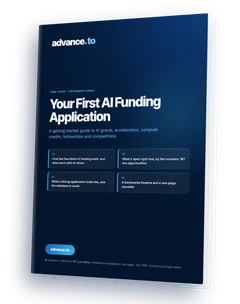
Get the free guide. Never miss a deadline.
Your First AI Funding Application shows you which AI funding fits you and how to write an application that gets read. Then, every Monday, one short email with the deadlines closing in the next 14 days.