
Home › Guides › Accelerators › Guide

Guide · Accelerators · 4 min read

How AI startup accelerators work

Accelerators trade money, mentoring and connections for a share of your company, or sometimes for nothing at all. This guide explains the deals, the differences between programmes and how applying works.

Some links on this page are affiliate links. We may earn a small commission at no extra cost to you.

What is an accelerator?

An accelerator is a fixed-length programme for early-stage startups, run in cohorts. You get some mix of investment, mentoring, a founder network, perks such as cloud credits and an introduction to investors, often at a demo day at the end. Most programmes last a few months.

In return, many accelerators invest in exchange for equity. Others are equity-free, funded by corporates, governments or universities.

The main types

Investment acceleratorsInvest cash for equity in each startup, e.g. Y Combinator's standard deal [source].
Pre-team programmesBack individuals before they have a co-founder or company, e.g. Entrepreneur First.
Equity-free programmesNo equity taken, often corporate- or publicly backed, e.g. Base44 Accelerator, Cohort 2 (2027), AI Founder Sprint 2027 and NEXT AI 2027 cohort.
Focused cohortsFor a sector, region or group of founders, e.g. Foundry3 Agentic AI Accelerator (women-led startups, 2027) for women-led startups building with agentic AI.
Generalist acceleratorsNot AI-specific but open to AI startups, e.g. techstars london accelerator 2027.

Accelerator, incubator or venture studio?

TypeStageLengthTypical deal
AcceleratorEarly, often with a product or prototypeFixed cohort, usually monthsInvestment for equity, or equity-free support
IncubatorIdea or very earlyOften open-endedSpace and support; terms vary widely
Venture studioThe studio starts the company itselfOngoingThe studio usually keeps a large stake

The labels are used loosely. Compare the actual terms: money, equity, length, location and obligations.

How much equity do accelerators take?

It ranges from nothing to a meaningful slice of your company, and the structure matters as much as the percentage.

  • Y Combinator invests $500,000: $125,000 converts into a fixed 7%, and $375,000 is invested on an uncapped MFN SAFE. YC's own worked example: if your next SAFEs are at a $15M post-money cap, the $375,000 converts to 2.5% [source].
  • Entrepreneur First: Up to $250K investment once you form a company; $600K+ in credits (incl. $350K Azure).
  • Equity-free: Base44 Accelerator, Cohort 2 (2027) lists 0% equity; up to $1M in startup perks per team; $75K cash prizes; NEXT AI 2027 cohort lists No equity, no funding (investor network access).

SAFEs. A SAFE (simple agreement for future equity) is an investment that converts into shares at a later priced round, usually subject to a valuation cap or discount. It was created by Y Combinator for US companies. UK-incorporated companies often use different instruments, so take legal advice on what you sign.

Who gets in?

How applying works

  1. Shortlist by deadline and terms. Our accelerators list shows each programme's published terms and deadline.
  2. Read the deal first. Know what you'd give up, where you'd need to be, and for how long, before you apply.
  3. Write a clear application. Expect questions on what you're building, who it's for, evidence of progress, and why your team. Some ask for a short video.
  4. Interview. Shortlisted founders are usually interviewed, often briefly.
  5. Talk to alumni. Founders from past cohorts are the best source on what a programme is really worth.

When are the deadlines?

Most accelerators run one or two cohorts a year with a fixed deadline for each, and some review applications on a rolling basis before the deadline, so applying early can help. A few accept applications at any time. Programme start dates are usually one to three months after the deadline: Foundry3 Agentic AI Accelerator (women-led startups, 2027), for example, closes in February for a cohort starting in March.

How we check these listings

Every accelerator on advance.to links to the programme's own page and shows the date we last checked it. We quote deals as the programme states them and say when terms aren't published. More guides are in our guides hub. Read more on our about page.
Open now: accelerators closing soonest

1 Dec10 days left

AI Founder Sprint 2027

Venture Lab (AI Founder Sprint) · Online

AcceleratorStartups & foundersOpen to anyoneGlobalOpen internationallyNo fees · no equity

Free 10-week virtual programmeno equity
Verified 20 Nov+ Add to calendar
1 Dec10 days left

Microsoft GenAI Studio at STATION F (2027 cohort)NEW

Microsoft (with ENGIE, NVIDIA, Mistral and partners) · Paris, France (STATION F)

AcceleratorStartups & foundersEurope

5-month accelerator at STATION Fwith cloud credits, AI workshops and access to the latest AI models; 2 seats in the Microsoft space
Verified 20 Nov+ Add to calendar
9 Dec18 days left

NEXT AI 2027 cohort

NEXT Canada · Toronto / Montréal / remote, Canada

AcceleratorStartups & foundersCanada

No equity, no funding (investor network access)
Verified 20 Nov+ Add to calendar

See all 12 open accelerators →

More on accelerators

Frequently asked questions

What does an accelerator give you?

Usually a mix of investment, mentoring, a founder network, perks such as cloud credits and introductions to investors, over a fixed programme of a few months.

How much equity do accelerators take?

From none to a meaningful stake. Y Combinator's standard deal is $500,000: $125,000 for a fixed 7% plus $375,000 on an uncapped MFN SAFE. Several programmes on our list are equity-free.

What's the difference between an accelerator and an incubator?

Accelerators run fixed-length cohorts for startups that are already moving, often with investment. Incubators usually support earlier ideas over a longer, open-ended period. The words are used loosely, so compare terms.

Do I need a co-founder?

Not always. Some programmes want a technical co-founder, while others, like Entrepreneur First, are designed for individuals who haven't found one yet.

Do I need to relocate?

Many programmes are in person in a specific city for some or all of the cohort. Check location and visa requirements before applying.

Can I apply with just an idea?

Some programmes accept idea-stage founders, but many ask for a product, prototype or early traction. Each listing shows the programme's stated eligibility.

What is a SAFE?

A simple agreement for future equity: an investment that converts into shares at a later priced round. It was created by Y Combinator for US companies, and UK companies often use different instruments, so take legal advice.

Sources

Programme details are quoted from the organisers' pages on the dates shown. advance.to isn't affiliated with any organiser.

  1. Y Combinator: The YC deal
  2. Entrepreneur First: Entrepreneur First (checked 20 Nov 2026)
  3. Base44 (Wix): Base44 Accelerator, Cohort 2 (2027) (checked 20 Nov 2026)
  4. Venture Lab (AI Founder Sprint): AI Founder Sprint 2027 (checked 20 Nov 2026)
  5. NEXT Canada: NEXT AI 2027 cohort (checked 20 Nov 2026)
  6. Foundry3: Foundry3 Agentic AI Accelerator (women-led startups, 2027) (checked 20 Nov 2026)
  7. MiraclePlus: MiraclePlus 2027 Spring Accelerator (checked 20 Nov 2026)
  8. Microsoft (with ENGIE, NVIDIA, Mistral and partners): Microsoft GenAI Studio at STATION F (2027 cohort) (checked 20 Nov 2026)

Share this page:

Free guide + the Monday email

Get the free guide. Never miss a deadline.

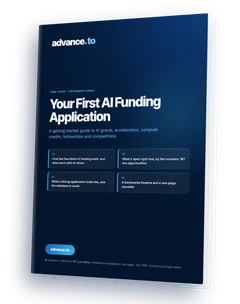
Your First AI Funding Application shows you which AI funding fits you and how to write an application that gets read. Then, every Monday, one short email with the deadlines closing in the next 14 days.

Remind me about

Deadline: . We email you 7 days before and again the day before (whichever are still ahead). Nothing else.

We send one email to confirm first; nothing else goes out until you click it. Reminders come from reminders@advance.to. See our privacy notice.